BCA Final Year Project
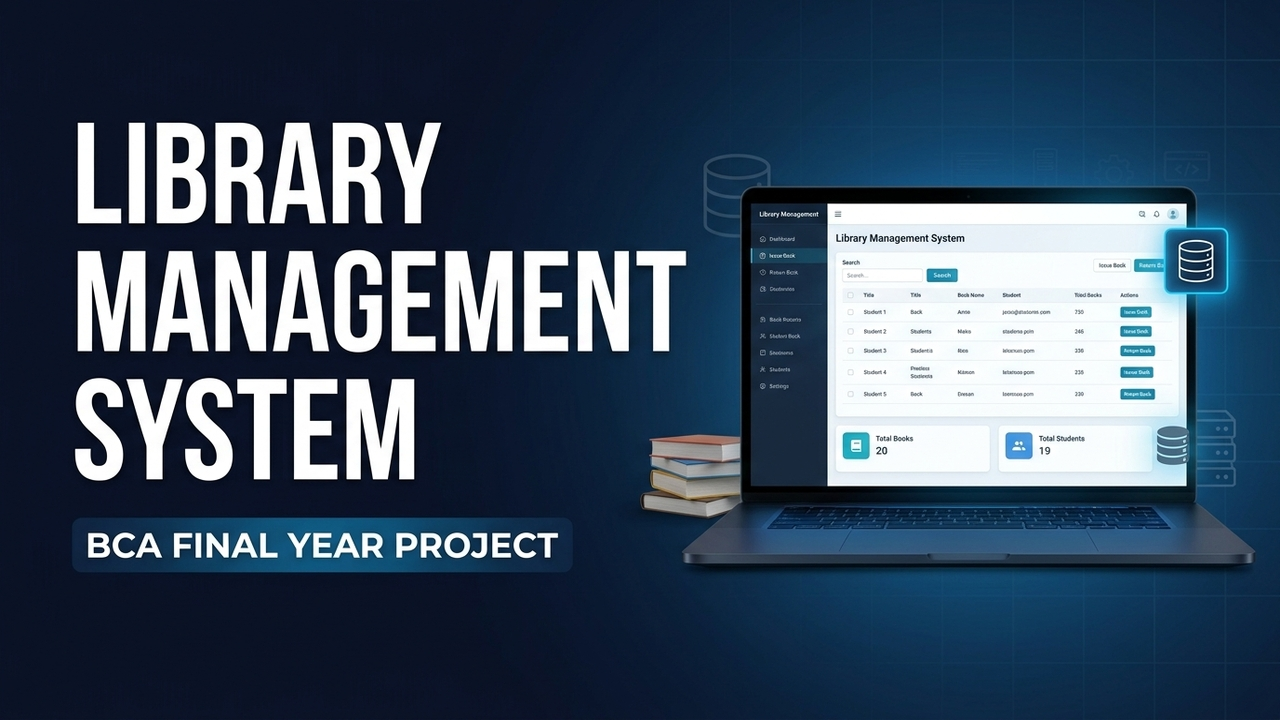
Are you a BCA student or Computer Science student searching for a practical Final Year Project? This Library Management System is a complete web-based project that you can use for your academic project, learning, demonstration, and project development.
The project includes the complete source code and project files, along with the required setup instructions to run the application on a Windows computer.
Library Management System – Final Year Project
A Library Management System is a useful choice for a BCA Final Year Project because it demonstrates several important concepts of software development, including database management, web development, authentication, CRUD operations, and business logic.
This project allows a library administrator to manage books, students/members, book issuing, returns, transactions, and other library records through a web-based interface.
The system is developed using:
- Python
- Flask
- SQLite
- HTML
- CSS
- JavaScript
- Bootstrap 5
- Font Awesome
SQLite is used as the database, so students do not need to install MySQL or another separate database server.
Project Features
The Library Management System includes both a public website and an admin panel.
Public Website
Visitors can:
- View available books
- Search for books
- Browse books by category
- Check book availability
- View individual book details
- Read library rules
- View information about the library
- Access the contact page
Admin Panel
The administrator can:
- Login securely
- View a dashboard
- Add new books
- Edit book information
- Delete books
- Manage library members
- Add new members
- Edit member records
- View member details
- Issue books
- Return books
- View transaction history
- Search and filter transactions
- View library reports
- Monitor available and issued books
Book Issue and Return System
The system also includes basic library business logic.
When a book is issued, its available quantity is automatically reduced. When the book is returned, the available quantity is increased again.
The system can also calculate overdue fines according to the configured fine rules.
This makes the project more than a simple database entry system and gives students an example of how business rules can be implemented in a web application.
Database
The project uses SQLite, which is included with Python.
The database contains tables for:
- Administrators
- Books
- Members
- Transactions
Students do not need to install MySQL, XAMPP, or a separate database server to run this project.
Source Code and Project Files
The complete project source code is provided with the project files.
The project folder contains the main application files, database code, templates, CSS, JavaScript, and requirements file.
A typical project structure is:
library/
│
├── app.py
├── database.py
├── requirements.txt
├── README.md
├── static/
│   ├── css/
│   └── js/
│
├── templates/
│   ├── admin/
│   └── public/
│
└── library.db
The project can be downloaded, opened in Visual Studio Code or another code editor, and run locally.
Technologies Used
| Technology | Purpose |
|---|---|
| Python | Application programming |
| Flask | Web framework |
| SQLite | Database |
| HTML | Web page structure |
| CSS | Styling |
| JavaScript | Client-side functionality |
| Bootstrap 5 | Responsive user interface |
| Font Awesome | Icons |
| Jinja2 | Dynamic HTML templates |
How to Run the Project
After downloading the source code, install Python 3 on your computer.
Open PowerShell or Command Prompt and go to the project folder.
For example, if the project is stored on the D: drive:
D:
cd library
Create a virtual environment:
python -m venv venv
Activate it:
.\venv\Scripts\activate
Install the required packages:
pip install -r requirements.txt
Start the application:
python app.py
Then open the following address in your web browser:
http://127.0.0.1:5000
The application should now be running on your local computer.
Default Admin Login
For demonstration purposes, the project includes a default administrator account.
Username: admin
Password: admin123
Students should change the default credentials if they deploy the application for actual use.
What Students Can Learn From This Project
This project can help BCA and Computer Science students understand how different parts of a web application work together.
By studying the source code, students can learn about:
- Python programming
- Flask web development
- SQLite database operations
- CRUD operations
- User authentication
- Sessions
- Database relationships
- Form handling
- Search and filtering
- Book issue and return logic
- Fine calculation
- HTML templates
- Bootstrap-based interfaces
- Basic web application security
Suitable for BCA Final Year Project
This Library Management System can be used as a starting point for a BCA Final Year Project or a Computer Science academic project.
Students can study the existing implementation and make their own modifications according to their university requirements. For example, additional modules such as email notifications, student ID cards, barcode scanning, advanced reports, or different user roles can be added as future enhancements.
The project can also be used for a project demonstration or viva preparation because it contains multiple components that can be explained during the presentation.
Final Year Project Report
Along with the source code, students can prepare a project report covering topics such as:
- Introduction
- Problem Statement
- Objectives
- Existing System
- Proposed System
- Requirements Analysis
- System Design
- Database Design
- Implementation
- Testing
- Results
- Limitations
- Future Enhancements
- Conclusion
Students should customize the report according to their own university’s format and project requirements.
Conclusion
A Library Management System is a practical project for students who want to understand how a complete web application is developed using Python, Flask, and SQLite.
The complete source code and project files make it easier for BCA students, Computer Science students, and Final Year Project students to study the project structure, understand the implementation, run the application locally, and extend it with additional features.
If you are working on a BCA Final Year Project, this project can provide a practical starting point for learning and developing your own Library Management System.